Temporal parallax
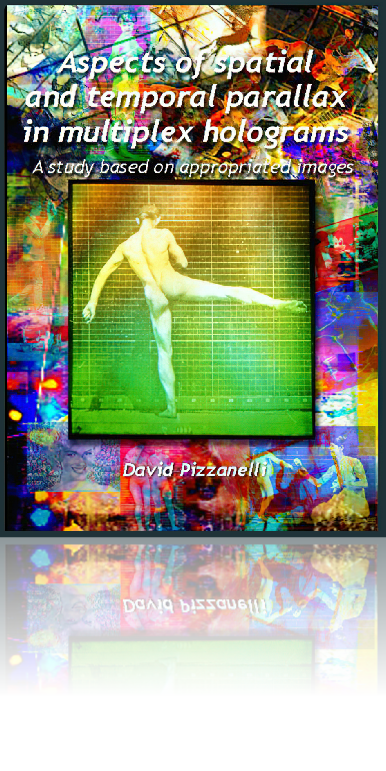
David Pizzanelli’s PhD thesis at the Royal College of Art, ‘Aspects of Spatial and Temporal Parallax in Multiplex Holograms, a study based on appropriated images’, is about a largely overlooked aspect of the three-dimensional imagery in motion film and television, called temporal parallax, and how this type of parallax can be converted, via the medium of holography, into stereoscopic parallax.
Since the 1970s it has been a cliché for reporters writing about holography to ask when three-dimensional television will be available. What is commonly overlooked is that an increasing percentage of motion film and television already has three-dimensional imagery. The dimensionality is provided by motion parallax (rather than stereoscopic parallax), caused by movement of the subject relative to the camera (or vice versa).
Motion parallax, or ‘temporal parallax’, is defined by N. A. Valyus in his book Stereoscopy as “the displacement of any image point which occurs in a time corresponding to the visual inertia of the eye relative to the image of the moving fixation point”. It might be better described as ‘memory parallax’, because the dimensionality of the scene is conveyed by the micro-memory of how the subject looks as it shifts perspective from one moment to the next.
A simple way of thinking of temporal parallax is to consider how a one-eyed man can still perceive that the world is three-dimensional by moving his head from side to side. Motion parallax provides a very compelling sense of three-dimensionality, and appreciation of this fact has been transforming cinema and television since the 1990s.
The new appreciation of the power of hand-held cinematography in the 1990s, made possible by new lightweight cameras, led to the inclusion of parallax in footage, which provided a heightened sense of immersion in the scene. The increased use of video, rather than film cameras, further facilitated the use of tracking shots that would have been difficult with the older, heavier equipment.
The use of temporal parallax in the movies really started to flourish in the late 1990s with the new capabilities of computer manipulation. The most significant example is Andy and Larry Wachowski’s The Matrix, where short sequences were made with 360-degree stereoscopic parallax (recording the subject with dozens of still cameras arranged in a circle) and shown in the film as temporal parallax, providing a powerful sense of three-dimensional space.
Although the use of temporal parallax is still increasing, both in cinema and television, little appears to have been written on the subject of temporal parallax in motion pictures.
See it at work in the holograms made from Muybridge’s photographs.